
Longcat Audio Technologies has updated H3D

Longcat Audio Technologies has updated H3D, their 3D audio binaural plugin for Digital Audio Workstations, to version 1.1.1 on Windows and MacOS. This update adds AudioUnit support on MacOS, and fixes general stability issues for both platforms.
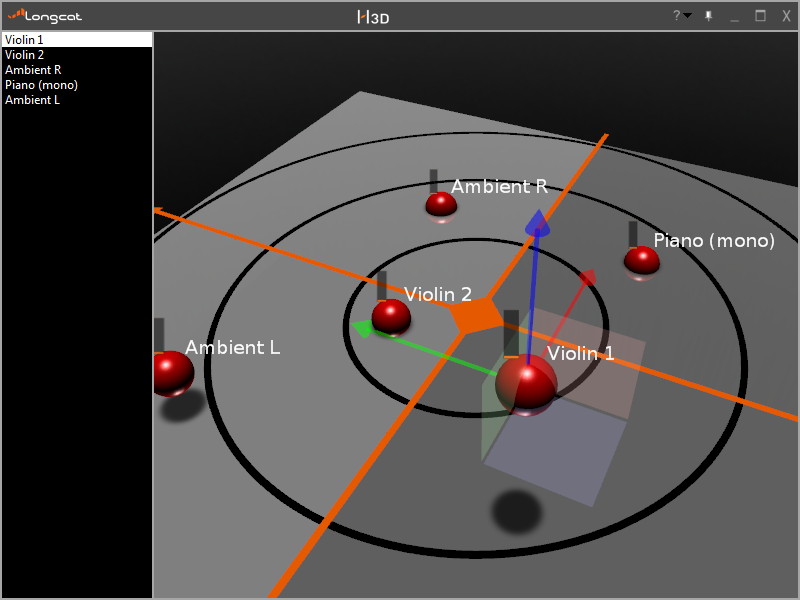
longcat_audio_-_h3d_-_screensh.pngAimed at musicians, sound designers or podcasts producers, Longcat’s H3D inserts in major audio software (such as Logic Pro, Digital Performer, Cubase, Live, Pyramix, Nuendo or Reaper), and allows the user to create immersive 3D mixes for headphones, by visually animating a large number of audio tracks in a full-3D interface.

  • 3D object-based mixing: use the 3D interface to visually place and animate sounds.
  • Longcat Audio H3D technology: when listening on headphones, H3D allows panning sound in 3D all around the listener’s head.
  • Unique HRTF processing: H3D uses Longcat own processed HRTF filters in order to achieve the best spatialization effects.
  • H3D Reverb included: immerse your tracks with H3D Reverb, Longcat’s 3D spatialized binaural reverberation.
  • Automation: fully automate parameters and 3D animation of audio tracks.
  • No tedious settings: Just insert H3D plugins and start moving sounds in 3D.

H3D is available immediately at 99€ (incl. EU VAT) in Longcat Audio’s online shop for Mac and Windows compatible AU or VST hosts. An evaluation version is freely downloadable on Longcat Audio’s website.

Comments

Popular posts from this blog

Bullet For My Valentine - Matt Tuck Guitar Gear Rig and Equipment

  Matt Tuck plays both rhythm guitar and also lead guitar, as well as being lead vocalist in the metalcore band Bullet for My Valentine. He can also play drums, keyboards, the recorder and harmonica. Let's look at some of the gear and equipment that has been seen in Matt Tuck's guitar rig.

This app makes your headphones sound like a pro recording studio

Spend some time shopping for headphones, and you’ll quickly grow tired of devices claiming to present music “as the artist intended,” despite sporting vastly different sound. But what if your favorite cans actually could sound like the recording studio where your favorite music was mixed? Enter SonarWorks, a company I’m guessing you’re not familiar with, as it’s best known in audio engineering circles for tuning professional studio speakers. Now SonarWorks is turning its attention to something more mainstream by calibrating headphones to sound like those same studios. The concept is simple. First you tell SonarWorks’ software, called True-Fi, which headphones you’re using; 138 models are supported, at the time of writing. It then modifies your PC’s audio output in order to “flatten” the frequency response into something very close to the neutral sound of a professional mixing studio. And I do mean very close.

Mastering Your Hybrid Setup: Integrating HX Stomp and TONEX Pedal for a Pro Workflow

Introduction: In modern music production, flexibility is the ultimate currency. Many guitarists are shifting toward hybrid rigs that combine the powerful modulation capabilities of a multi-effects processor with the hyper-realistic, AI-based tone modeling of pedals like the TONEX. Today, we’re breaking down how to integrate your Line 6 HX Stomp and IK Multimedia TONEX Pedal to create a seamless, professional ecosystem for both live performance and studio recording. Key Points: Optimizing Your Signal Chain: The Hybrid Approach: Use the HX Stomp for your modulation, delay, and reverb effects, while leveraging the TONEX Pedal for your core amp and cabinet tones. Loop Configuration: By placing the TONEX Pedal within the effects loop of the HX Stomp, you gain granular control over your gain staging, ensuring that your effects hit the "amp" exactly where you want them. Mastering MIDI Synchronization: Clock Sync: Keep your time-...