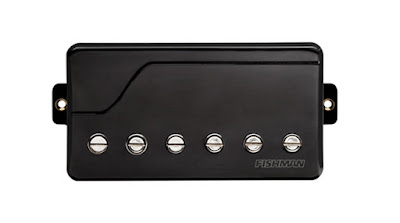
The electric guitar pickup has been wound since 1934. 80 years later, we’ve unwound it. Original and totally re-imagined, Fishman Fluence pickups are free from the hum, noise and frustrating inductance issues that plague even the most coveted wire-wound pickups—revealing pure, uncorrupted and musical tone. With a couple of notable exceptions, new electric-guitar pickup technology tends to not fare well in the marketplace. Sometimes it’s because the new designs seem more for engineering’s sake than sound’s. But most often it’s because guitarists are addicted to classic tones achieved using World War II-era technology. “If it ain’t broken, don’t fix it,” is our basic MO. Heck, even many radical experimentalists prefer vintage pickups as starting points for their aural anarchy.
So why did revered acoustic pickup and amplification guru Larry Fishman venture into this world filled with, as he put it last year, “too much voodoo”? In a nutshell, because he felt the technology behind his Fluence pickups could yield impeccable 20th-century tones and bring something new to the table. Here we’re testing that premise with a set of Fluence Classic Humbuckers installed in a 2014 Gibson Les Paul Traditional Pro.
Manufacturers big and small use terms like “vintage,” “classic,” and “old school” to describe their pickups’ sonic characteristics. But these descriptors are tricky, and subjective. There are simply too many variables at play in a vintage setup to predict exactly what tones will emerge: Even if you’re only looking at the electrical circuit of, say, a ’59 Les Paul, variables from materials used, true (vs. labeled) electrical-component values, and pickup-winding approaches can result in very different-sounding instruments from one ’59 to another.
For those looking to imbue their own instrument with vintage tones, Fishman proffers a route that’s theoretically more consistent and repeatable from pickup set to pickup set. They started by painstakingly measuring the complex tonal, electrical, and magnetic-field data from select vintage pickups and identifying parameters that seemed most definitively “classic.” Then they created pickups around those parameters using two 48-layer coils printed on stacks of thin circuit boards. It’s 9V-powered aerospace technology that virtually eliminates unpredictable electrical variances while offering added flexibility and reducing noise that’s characteristic of many vintage designs.
I’ll admit to some skepticism when I first heard about Fluence pickups. Though they’re not digital, my kneejerk reaction was to think of experiences with amp-, effect-, and instrument-modeling devices that left me wanting for the real thing. But I became intrigued when I ran into Larry Fishman at Musikmesse this year. Larry is an accomplished player of upright bass who proved his mettle in acoustic gear ages ago. And based on his company’s history few would expect him to rave about how the best old PAFs (the “patent-applied-for” humbuckers in the earliest Les Pauls) are very single-coil like in their ability to transfer nuance. As a single-coil fan precisely because so many humbuckers mask dynamic subtleties, I thought, “Okay, I gotta try these.”
Fluence Classics have two voice modes that are selectable via push-pull tone knobs. Mode 1 (push-pull pots down) is vintage PAF-style. In the bridge position, this voice delivered incredible note detail through my Jaguar HC50 and Goodsell Valpreaux 21 amps. Moderate overdrive and medium pick attack yielded crunchy, harmonically complex classic rock with nice note separation and that wonderfully open, slightly microphonic (in a wonderful way) sound that so many great PAFs have. It reminded me a lot of Seymour Duncan’s Seth Lover humbuckers. (Premier Guitar)
So why did revered acoustic pickup and amplification guru Larry Fishman venture into this world filled with, as he put it last year, “too much voodoo”? In a nutshell, because he felt the technology behind his Fluence pickups could yield impeccable 20th-century tones and bring something new to the table. Here we’re testing that premise with a set of Fluence Classic Humbuckers installed in a 2014 Gibson Les Paul Traditional Pro.
Manufacturers big and small use terms like “vintage,” “classic,” and “old school” to describe their pickups’ sonic characteristics. But these descriptors are tricky, and subjective. There are simply too many variables at play in a vintage setup to predict exactly what tones will emerge: Even if you’re only looking at the electrical circuit of, say, a ’59 Les Paul, variables from materials used, true (vs. labeled) electrical-component values, and pickup-winding approaches can result in very different-sounding instruments from one ’59 to another.
For those looking to imbue their own instrument with vintage tones, Fishman proffers a route that’s theoretically more consistent and repeatable from pickup set to pickup set. They started by painstakingly measuring the complex tonal, electrical, and magnetic-field data from select vintage pickups and identifying parameters that seemed most definitively “classic.” Then they created pickups around those parameters using two 48-layer coils printed on stacks of thin circuit boards. It’s 9V-powered aerospace technology that virtually eliminates unpredictable electrical variances while offering added flexibility and reducing noise that’s characteristic of many vintage designs.
I’ll admit to some skepticism when I first heard about Fluence pickups. Though they’re not digital, my kneejerk reaction was to think of experiences with amp-, effect-, and instrument-modeling devices that left me wanting for the real thing. But I became intrigued when I ran into Larry Fishman at Musikmesse this year. Larry is an accomplished player of upright bass who proved his mettle in acoustic gear ages ago. And based on his company’s history few would expect him to rave about how the best old PAFs (the “patent-applied-for” humbuckers in the earliest Les Pauls) are very single-coil like in their ability to transfer nuance. As a single-coil fan precisely because so many humbuckers mask dynamic subtleties, I thought, “Okay, I gotta try these.”
Fluence Classics have two voice modes that are selectable via push-pull tone knobs. Mode 1 (push-pull pots down) is vintage PAF-style. In the bridge position, this voice delivered incredible note detail through my Jaguar HC50 and Goodsell Valpreaux 21 amps. Moderate overdrive and medium pick attack yielded crunchy, harmonically complex classic rock with nice note separation and that wonderfully open, slightly microphonic (in a wonderful way) sound that so many great PAFs have. It reminded me a lot of Seymour Duncan’s Seth Lover humbuckers. (Premier Guitar)
Tosin Abasi's Fishman Fluence Signature Pickup Shootout
x